
Authors and Theorists
Roger Kennedy
Dr Roger Kennedy is a training analyst of the British Psychoanalytical Society and served as its President between 2004 and 2006. He also worked for many years as a psychiatrist in the NHS.
In many papers and books written over the past four decades, Kennedy has ventured into a wide array of compelling and often thorny topics, from the endlessly complex problem of human subjectivity, to the force that music exerts in our lives, to the frightening yet inescapable presence of evil in society and within ourselves. Philosophy and the arts have played a central role in his writing career, and he instinctively approaches his psychoanalytic explorations from this interdisciplinary position.
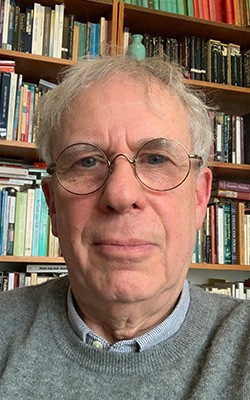
Dr Roger Kennedy is a training analyst of the British Psychoanalytical Society and served as its President between 2004 and 2006. He also worked for many years as a psychiatrist in the NHS.
In many papers and books written over the past four decades, Kennedy has ventured into a wide array of compelling and often thorny topics, from the endlessly complex problem of human subjectivity, to the force that music exerts in our lives, to the frightening yet inescapable presence of evil in society and within ourselves. Philosophy and the arts have played a central role in his writing career, and he instinctively approaches his psychoanalytic explorations from this interdisciplinary position.
Kennedy initially trained in medicine, going on to practise as a psychiatrist in the NHS. For thirty years he worked as a Consultant Family Psychiatrist in the Family Unit at the Cassel Hospital, Richmond, and his experiences working with children, adolescents, and families have had a deep and enduring influence on his clinical practice, his psychoanalytic thinking, and his writing.
His early experiences in adult psychiatry were, however, difficult: he found the work frustrating, often hopeless, due to the severely limited treatments available to patients at that time, and the crudeness and harshness of those that were on offer. He soon found that he much preferred working in child and family psychiatry, which he trained in at the Tavistock Clinic. He had long wished to become a psychoanalyst and to have his own analysis, and he began his training in 1976 while working in psychiatry. Indeed, the mental and emotional demands of his work made entering into his own analysis seem crucial, not only as a professional step but as a source of personal support.
Both in his clinical practice and in his writing, Kennedy has been influenced by a wide variety of analysts, including Freud, Winnicott, Christopher Bollas, Jonathan Sklar, Juliet Mitchell, Gregorio Kohon, and Michael Parsons, to name a few. He aligns himself with the pluralistic theoretical stance of the British Independent group, in particular with its exponents’ emphasis on the environment – both in a broad sense and more specifically in relation to the environment of the consulting room. His own analyst, John Klauber, had a formative impact on his work, and Kennedy was particularly influenced by Klauber’s emphasis on the patient’s freedom of thought and the importance of spontaneity in psychoanalysis, especially spontaneity in the analyst’s responses.
The nature of human subjectivity has been an abiding preoccupation of his for many years, one he first explored in depth in his 1998 book The Elusive Human Subject. In that text he grappled with the aspect or portion of human subjectivity which always escapes our comprehension, whether we approach the problem from a psychoanalytic, neuroscientific, historical, or in fact any other perspective. As a psychoanalyst, Kennedy is all too aware that an idea as vast and complicated as the ‘human subject’ will always remain to some extent a puzzle; that every interpretation is necessarily incomplete, and there is always something out of reach.
Connected to this area of enquiry, Kennedy went on to develop the concept of a ‘psychic home’ (2014), a fundamental psychic constellation that confers upon each of us a sense of safety, rootedness, and that acts as a home for what we might call the human soul. It is, in his understanding, the fear of losing this psychic home that feeds much intolerance. This idea of ‘home’ in turn found resonances in his book The Power of Music, where he extended the idea in relation to a musical work’s ‘home key’, from which the piece unfolds and to which it returns at its close. The Power of Music examines why music is such a potent force in our lives from the beginning, describing how babies, especially in the very first weeks and months of life, are extremely finely attuned to speech tones – one might say to the ‘music’ of speech. He then considers the ‘music’ of patient and analyst while they are speaking in the session, and how their attunement to one another’s music can be an important part of the analytic work.
In a more recent book, The Evil Imagination, he again interlaces ideas and examples from religion, history, politics, and neuroscience with clinical vignettes, all in the service of trying to find out what makes people able (or unable) to resist evil. In his 2026 book, Creating a Human Psychoanalytic
Setting: Clinical Studies, he returns to his earlier work thinking about the individuality, freedom, and humanity of the patient in the analytic encounter. Here he focuses on how each individual’s external life circumstances, history, and social context affect what can take place within their analysis, and explores how analysts themselves must negotiate the demands and limitations of their professional and institutional realities.
The question of subjectivity and subject relations is what unites all of Kennedy’s intellectual interests, arising as it does out of everything we as humans produce and experience: art, society, philosophy, psychoanalysis, politics. Theory of various kinds, therefore, underpins all of his writing, and he engages rigorously with scholarship across disciplines. However, he tries to balance this rigour with a style as lucid and direct as possible, and has found in Winnicott’s writing an important model for such directness of expression, and Kennedy similarly seeks to engage as wide a readership as possible by combining diverse examples and references with a clarity of expression. Equally, he has found inspiration in Freud’s richly allusive and literary texts, which famously draw on literature, myth, art, philosophy, and history in tandem with his emerging theories and illustrative clinical examples.
By Eleanor Sawbridge Burton, 2026
Key publications:
- Kennedy, R. (2026) Creating a Human Psychoanalytic Setting: Clinical Studies. London: Routledge.
- Kennedy, R. (2025) Psychoanalysis, Society and Culture: Building Bridges. London: Routledge.
- Kennedy, R. (2022), The Evil Imagination: Understanding and Resisting Destructive Forces. London: Phoenix Books.
- Kennedy, R. (2020) The Power of Music. London: Phoenix Books.
- Kennedy, R. (2019) Tolerating Strangers in Intolerant Times. London and New York: Routledge.
- Kennedy, R. (2014) The Psychic Home. London and New York: Routledge.
- Kennedy, R. (1998) The Elusive Human Subject: A Psychoanalytic Theory of Subject Relations. London and New York: Free Association Books.